Turn It Up and Terrify Me: How Horror Scores Rewire Your Brain Before the Monster Shows Up
Close your eyes during a horror movie and you'll probably still know exactly what's coming. That's not a coincidence — it's sound design working exactly as intended. Horror is the only genre where the soundtrack routinely does more work than what's on screen, and once you start paying attention to it, you can't stop.
The Screech That Started It All
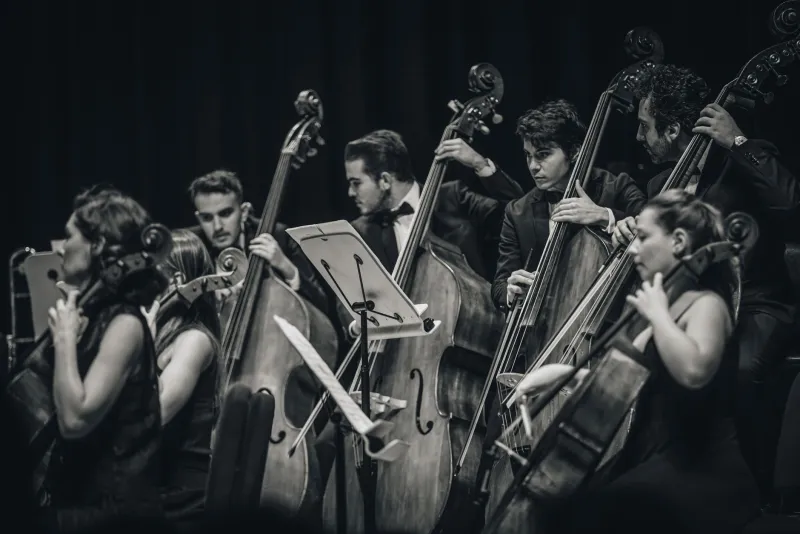
Bernard Herrmann's score for Psycho is the genre's Big Bang. Those shrieking violins during the shower scene were so aggressive that Hitchcock originally wanted the sequence scored with nothing but ambient sound. Herrmann pushed back, quietly composed the piece anyway, and Hitchcock — famously a control freak — admitted the music was responsible for nearly half the scene's impact.
What Herrmann understood was that dissonance feels like danger. The strings don't mimic a scream by accident; they're literally played at the edge of what the instruments can do, and your nervous system responds to that strain. Sixty-plus years later, composers are still stealing from that playbook.
Your Brain on Dissonance
There's actual science behind the dread. Studies on film music have found that horror scores lean heavily on sounds humans are wired to fear: predator growls, infant cries, and — the big one — screams. Researchers call them "nonlinear vocalizations," and film composers have spent decades building entire palettes around them.
Take the Saw theme. That low, pulsing drone isn't melodic in any traditional sense — it's a manufactured feeling of unease you can't shake. Or consider the Halloween franchise, where John Carpenter's simple five-note piano motif on a synthesizer somehow communicates pure evil without a single lyric or orchestral swell. Carpenter scored it himself on a shoestring budget, which might be the most punk rock move in horror history.
The trick, composers say, is that horror music works on anticipation rather than payoff. A love song needs the romance. An action cue needs the explosion. Horror music needs only the waiting — the creak, the held note, the silence before the violin stabs.
The Synthwave Takeover
Fast forward to the 2010s, and horror rediscovered the analog synthesizer. Stranger Things gets the credit for the mainstream revival, but horror films like It Follows (Disasterpeace's score is a masterclass in dread-as-drone) and Suspiria's 2018 remake, with Thom Yorke's unsettling contribution, proved that retro synths weren't just nostalgia bait.
There's a practical reason for the trend: synths sound wrong in a way orchestras don't. A violin vibrates like a human voice. A Moog vibrates like nothing in nature. When your score sounds like a dying machine, your audience's brain fills in the blanks with monsters.
Five Scores That Still Slap, Ranked
- Halloween (1978) — Carpenter's 5/4 piano riff remains the most efficient piece of terror ever recorded.
- Psycho (1960) — Herrmann's strings are the blueprint everything else is built on.
- The Exorcist (1973) — Mike Oldfield's "Tubular Bells" turned a prog-rock oddity into the sound of demonic dread.
- Hereditary (2018) — Colin Stetson's score doesn't accompany the horror; it is the horror. That wailing brass will live in your head rent-free.
- It Follows (2014) — Disasterpeace made an 8-bit nightmare out of synthesizers and silence.
Why You Remember the Sound, Not the Scare
Here's the thing about jump scares: they fade. Watch Insidious twice and the big moment loses maybe half its punch. But that low rumble underneath the scene? Still works every time. Music bypasses the part of your brain that knows you're watching a movie, which is why a great horror score can terrify you even when you know exactly what's coming.
So this October, do something a little different. Put on one of these scores while you're carving pumpkins or handing out candy. You don't need the movie. The music was doing the scaring all along.