Check the Aisle, Check Under the Bed: How Ordinary Stuff Became Horror's Deadliest Props
Somewhere in your house right now is a horror movie villain. It's not hiding in the closet. It's sitting on a shelf, in a bathroom, or in a box in the basement, and it got there because you bought it at a store like every other normal American.
That's the dirty secret of the horror genre: its most iconic monsters were never monsters at all. They were products. Mass-produced, shipped in bulk, sold at a markup. The scariest things in cinema history came off the same assembly lines as toaster ovens and garden hoses.
The VHS Tape: Horror's First Self-Aware Killer
Start with the big one. The Ring didn't need a demon or a slasher with a machete. It needed a VHS tape — a format that by 2002 was already gathering dust in every American living room. That's the genius of it. The movie weaponized obsolescence. Everyone watching had a stack of those black plastic rectangles somewhere, and suddenly every unlabeled tape in the collection became a potential death sentence.
The marketing wrote itself. You didn't just watch The Ring; you went home and looked sideways at your entertainment center. That's a product doing the heavy lifting of a monster, and it cost the studio nothing extra.
Mirrors: The Cheapest Scares in the Business
The mirror is horror's workhorse, and it works because of a marketing quirk nobody thinks about. Mirrors are sold as vanity products — beauty, self-image, checking your eyeliner. Horror took the exact same object and made it the doorway to everything wrong.
Candyman said his name in one. Oculus built an entire haunted house story around one. Every bathroom mirror shot in every jump scare since is the industry admitting something: the reflection is the one place you can't look away from. Directors have been mining that seam for a century because it's free, it's universal, and every single viewer owns the prop.
The Toy Aisle Is a Horror Backlot
Here's where it gets a little conspiratorial, in the fun way. Walk the toy aisle of any Walmart in October and you're basically touring a horror museum.
Dolls came first. The Chucky franchise took the quintessential American toy — the kind of thing grandmothers buy without thinking — and made it stabby. The doll was already slightly unnerving thanks to that uncanny-valley face; the movie just gave it a knife and a mouth.
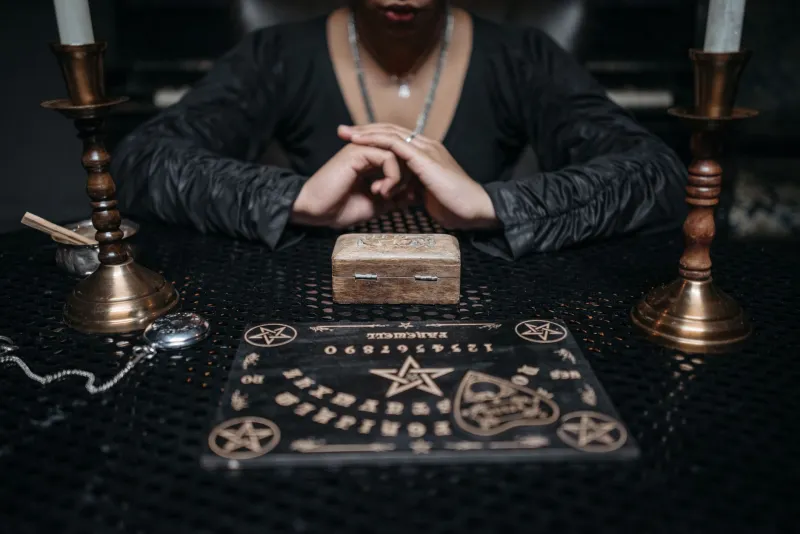
Then there's the Ouija board, which might be the greatest accidental horror franchise in history. It wasn't designed as a movie prop. It was designed as a parlor game, patented in 1891, sold as innocent spiritualist fun. Hasbro still sells it today, in the same aisle as Monopoly. Hollywood has spun it into at least a dozen films, and the board itself has never needed a redesign. The product was the marketing.
Corn Syrup and the Great Blood Economy
Even the gore is a consumer product. Ask any horror effects person what's in the squibs and the answer is usually a corn syrup base — Karo syrup, food coloring, maybe some peppermint flavoring so actors don't gag. The blood that drenched a thousand VHS covers was originally bought at a grocery store, probably by a PA with a production budget of forty bucks.
There's something perfect about that. The genre's most transgressive imagery, the stuff that got movies slapped with X ratings and Senate hearings, was made with the same syrup that goes on your pancakes.
Why Capitalism Keeps Feeding the Monster
So why does this keep happening? Simple economics, mostly. Horror runs on tight budgets, and the cheapest special effect in the world is an object the audience already owns. You don't have to build a monster from scratch — you just have to make someone afraid of their own television.
There's also a merchandising flywheel. A killer product becomes a movie, the movie sells the product back to you as a collectible, and the collectible sits on your shelf waiting for the reboot. Spirit Halloween's entire business model is proof: the pop-up store sells you the props, and the props sell you the fear, and the fear sells you the props again next year.
It's a closed loop, and we're all in it willingly. Nobody's complaining.
Check Your House
So here's your homework. Tonight, before you press play on whatever HalloweenFlix pick you've queued up, take a quick inventory. A mirror in the bathroom. A doll on a shelf, maybe yours from childhood. A VHS tape in a box if you're of a certain age. A Ouija board in the closet from that one sleepover in 1998.
You own the props. Hollywood just figured out how to make them scream. Every October starts here — probably in your own hallway.